
Niraj Welikala | Astrophysics, Cosmology & Data-Driven Modelling
Research in galaxy formation, star formation and weak-lensing systematics using ground- and space-based telescope data, image modelling, statistical inference, and computational methods. Available for research mentorship with motivated students in astrophysics and applied data science.
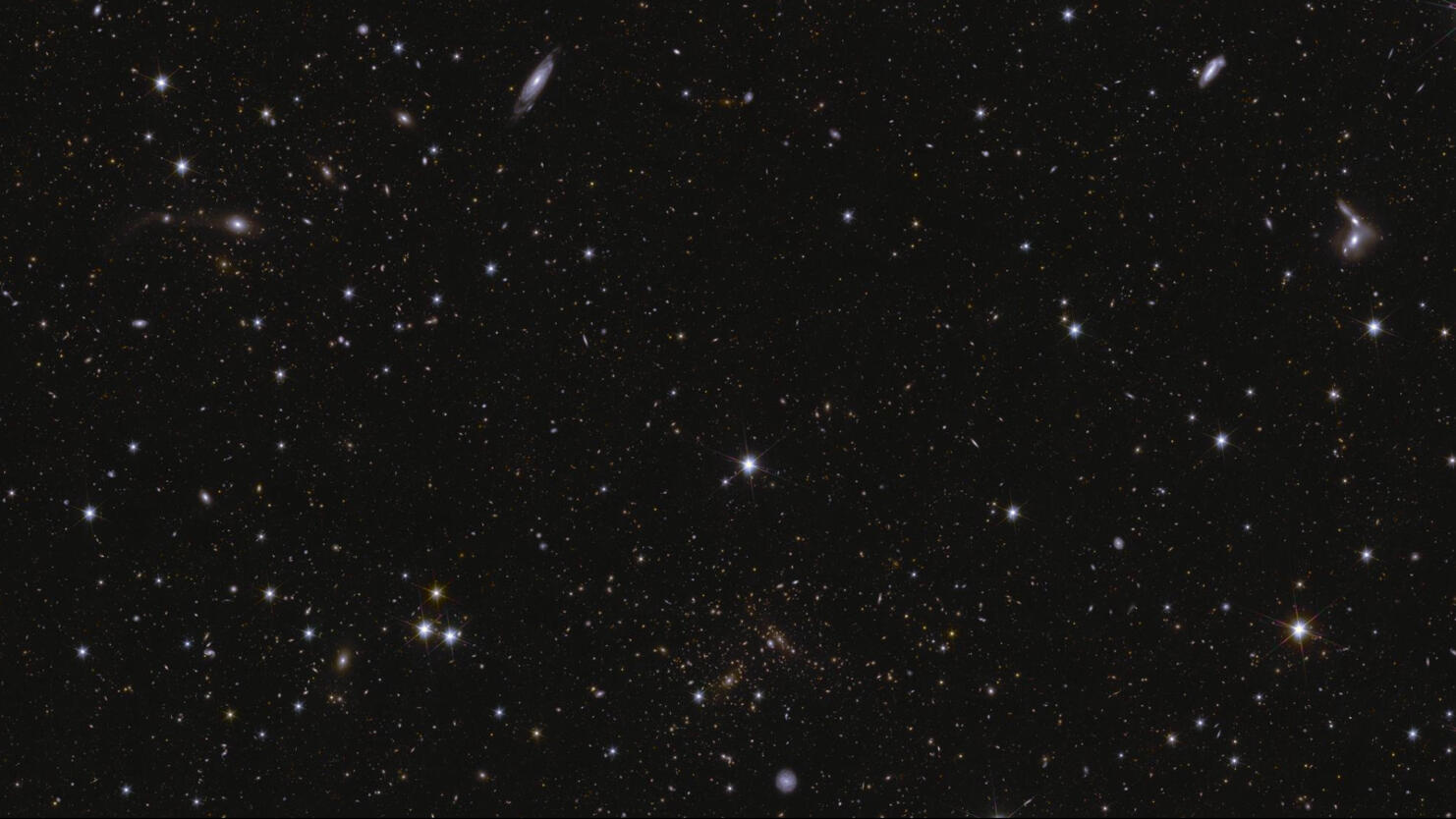
Euclid Deep Field South: After just one visit, ~11 million galaxies were imaged across ~28 deg², revealing early structure in the cosmic web. Credit: ESA/Euclid Collaboration
Research Overview
My research focuses on understanding how galaxies form and evolve, including the roles of star formation, environment and internal galaxy processes. I have also worked in observational cosmology through galaxy modelling for weak gravitational lensing measurements, which are used to constrain Dark Matter and Dark Energy with high precision. My work in astrophysics has combined advanced computational methods, physics-based modelling and statistical inference, and increasingly machine learning and data science methods applied to large astronomical datasets.
Selected Research Contributions
pixel-z
Developed a method of spatially resolving stellar populations and their properties (e.g. star formation, dust and metallicity) within galaxies using broad-band colours of individual pixels - applied to thousands of galaxies in Hubble Space Telescope and ~70,000 galaxies in the Sloan Digital Sky Survey Link to paperHigh redshift sub-millimetre galaxies
- Led a joint project between the ESA-NASA Planck mission and the South Pole Telescope (SPT) investigating high-redshift strongly lensed dusty star-forming galaxies, including evidence for enhanced star formation and clustering in foreground dark matter haloes Link to paper Galaxy colour gradients and weak-lensing systematics
Led the core galaxy-modelling work for ESA Euclid mission's pre-launch control of weak-lensing systematic bias arising from galaxy colour gradients, supporting precision measurements of dark matter and dark energy. Link to paperFirst Galaxies simulations
Developed spectral simulations for observations of the First Galaxies that formed in the Epoch of Reionisation (redshifts between 5-20) with the EAGLE instrument proposed for the European Extremely Large Telescope (E-ELT). Link to paper
Research & Mentorship Interests
Galaxy formation and evolution
Star formation in distant galaxies
Spatially resolved properties of galaxies: morphology, colour gradients, resolved stellar populations
Weak gravitational lensing
Astronomical image analysis
Statistical inference
Computational astrophysics
Machine learning for astronomical surveys
Data science with astronomical datasets (Python, C/C++, Machine Learning, image analysis)
Hands-on computational projects for students new to research
Mentoring students in applied data science and astrophysics research
Education & Affiliations
MPhys (Oxford), Diploma in Computer Science (Cambridge), PhD Astrophysics (University of Pittsburgh, USA)
Honorary Fellow - University of Edinburgh
Builder - Euclid Collaboration
Fellow - Royal Astronomical Society
Former Beecroft Fellow in astrophysics (Oxford), former CNRS/CNES postdoctoral fellow (France)